Introduction
When productivity tools on the market get caught up in a race for features, a WeChat mini-program called “Xiangshang Plan” has chosen a completely different path. It redefines the core value of efficiency tools—not by selling anxiety through a pile of functions, but by silently conveying a methodology through structured planning templates, zero learning cost interactions, and design logic supported by cognitive science. From OKR mapping to a two-hour deep work module, this product, completed by a junior student using AI-assisted programming, demonstrates a new generation of product managers’ deeper understanding of what should be done over what can be done.
 The author of this article is a junior computer science student seeking an internship in product management. This mini-program was developed entirely using Vibe Coding (AI-assisted programming) from PRD writing to code deployment. This article will provide a comprehensive review of the product’s design logic, theoretical support, and differentiation strategy from a product manager’s perspective.
A Hard Truth: 90% of To-Do Apps Don’t Survive a Week
I conducted an informal survey asking 50 classmates if they had a to-do tool on their phones; 48 said yes. When asked if they were still using it, only 3 raised their hands.
The stories of the remaining 45 were almost identical:
They downloaded a task manager, faced with a pile of concepts like “lists, tags, priorities, smart lists, Pomodoro timers, Eisenhower matrices,” and spent half an hour just figuring out how to use it. After finally creating a few lists, they opened the app the next day to find a screen full of tasks, feeling more anxious than when they hadn’t planned at all.
Then they uninstalled it.
They downloaded Todoist, Notion, Things 3… and the cycle repeated, leaving only a native app called “Notes” with three words: Be Disciplined.
This isn’t a matter of willpower; it’s a product design issue.
I began to ponder a fundamental question: What is the core contradiction of efficiency tools?
The answer is that most efficiency tools sell “feature richness,” but what users truly need is “cognitive load reduction.”
Thus, I created a WeChat mini-program called “Xiangshang Plan.”
Product Positioning: Not Just Another To-Do List, But a Methodology of Silent Delivery
One-Sentence Definition
Xiangshang Plan = Structured Planning Templates + Minimalist Interaction + Zero Learning Cost
In the efficiency tool space, I positioned the product in an extremely precise quadrant: extreme simplicity × zero learning cost.
This means we deliberately abandoned advanced features like tags, priorities, subtasks, Gantt charts, Pomodoro timers, and calendar views. It’s not that we couldn’t do them; we chose not to.
Core Value Proposition
Efficiency tools on the market can be divided into three categories:
- Heavy Task Management (Notion, Todoist, Things 3) — Comprehensive features but steep learning curves, deterring 90% of light users.
- Lightweight To-Do Lists (Dida List, Minimalist To-Do) — Moderate features but still require users to build their planning systems.
- System Native Reminders (Apple Reminders, Google Tasks) — Good experience but platform-locked, and do not provide a methodology.
They share a common blind spot: they provide “tools” but not “methods.”
When users open a to-do app, they face a blank slate. The tool says, “Go ahead, write anything,” but the user’s internal OS is, “I know I want to improve, but I don’t know how to break down my goals.”
Xiangshang Plan’s differentiation strategy is to internalize goal management methodologies into the product structure itself.
Users don’t need to learn terms like OKR, SMART, or GTD—when they open the mini-program, they see four preset modules: “Annual Plan, Monthly Plan, Daily Plan, Two-Hour Deep Work.” This structure itself is a productized expression of methodology.
Through usage, users naturally complete the full chain of “goal breakdown → milestone setting → daily execution → deep focus” without even realizing they are using any theory.
This is my proudest design decision: the best methodology is one that users are unaware of.
Theoretical Foundation: Each Module is Backed by Cognitive Science
As a product person, I am extremely cautious about “brainstorming features.” Every module in Xiangshang Plan has been supported by validated theories.
Annual-Monthly-Daily Planning System
This structure integrates three classic frameworks:
- OKR Mapping: Annual Plan = Objective (Direction), Monthly Plan = Key Results (Milestones), Daily Plan = Tasks (Execution Items). Users naturally complete the hierarchical breakdown of goals.
- SMART Principles: Goals are forced into annual/monthly/daily time containers, naturally satisfying the Time-bound dimension.
- Begin with the End in Mind (Stephen Covey): The structure guides users from long-term vision to daily actions.
Scientific validation? A study from Dominican University (Dr. Gail Matthews, 2015) shows that people who write down and structure their goals achieve them at a rate 42% higher than those who only think about them.
Two-Hour Deep Work Module — The Most Hardcore Design
This module is inspired by Elon Musk’s time management philosophy: reverse engineering and quantification.
The core insight is that many people don’t want to work or waste time; they just lack a concrete perception of time and can’t connect goals with tasks.
Why two hours? Cognitive neuroscience provides the answer—humans have an ultradian rhythm (Kleitman, 1963) with cycles of 90-120 minutes. During this window, the prefrontal cortex is at its peak cognitive ability, and attention significantly declines beyond this threshold.
The two-hour time box captures the physiological window of maximum brain energy.
On the product level, I divided the day into 12 two-hour segments (from 00:00-02:00 to 22:00-24:00), automatically locating the current time segment. Users only need to do one thing: fill in “What do I want to focus on during this time?”
Key design decision: This module has no “completed/incomplete” status.
The two-hour module is not a task list but a time box thinking training tool. The content represents “what to focus on during this period,” and as time passes, the content naturally fulfills its mission.
This design directly counters two psychological effects:
- Parkinson’s Law: Work expands to fill all available time. The two-hour hard constraint forces users to cut out non-core elements.
- Choice Anxiety: Doing only one thing per time segment eliminates decision fatigue from multitasking.
Habit Module: A Non-Tracking Thinking Container
All habit-related products on the market focus on tracking. I took the opposite approach—Xiangshang Plan’s habit module has no tracking mechanism.
Why?
Self-Determination Theory (Deci & Ryan, 1985) in behavioral psychology suggests that external rewards (like consecutive tracking days) can undermine intrinsic motivation. When users forget to track one day and “break the chain,” the frustration can lead to complete abandonment.
James Clear states in “Atomic Habits” that true good habits are not actions like “running for 30 minutes every day” but identity recognition like “I am a person who values health.”
Thus, Xiangshang Plan’s habit module is a thinking container—users store motivational quotes, thought patterns, and behavioral principles. It serves as a continuously visible mental anchor, not a tracker that makes you feel guilty for breaking the chain.
The secret to long-term persistence is to ignore interruptions.
Product Architecture: Six Modules Covering 90% of Planning Management Scenarios
The homepage of Xiangshang Plan features a six-grid card entry, modeled after Apple Reminders:
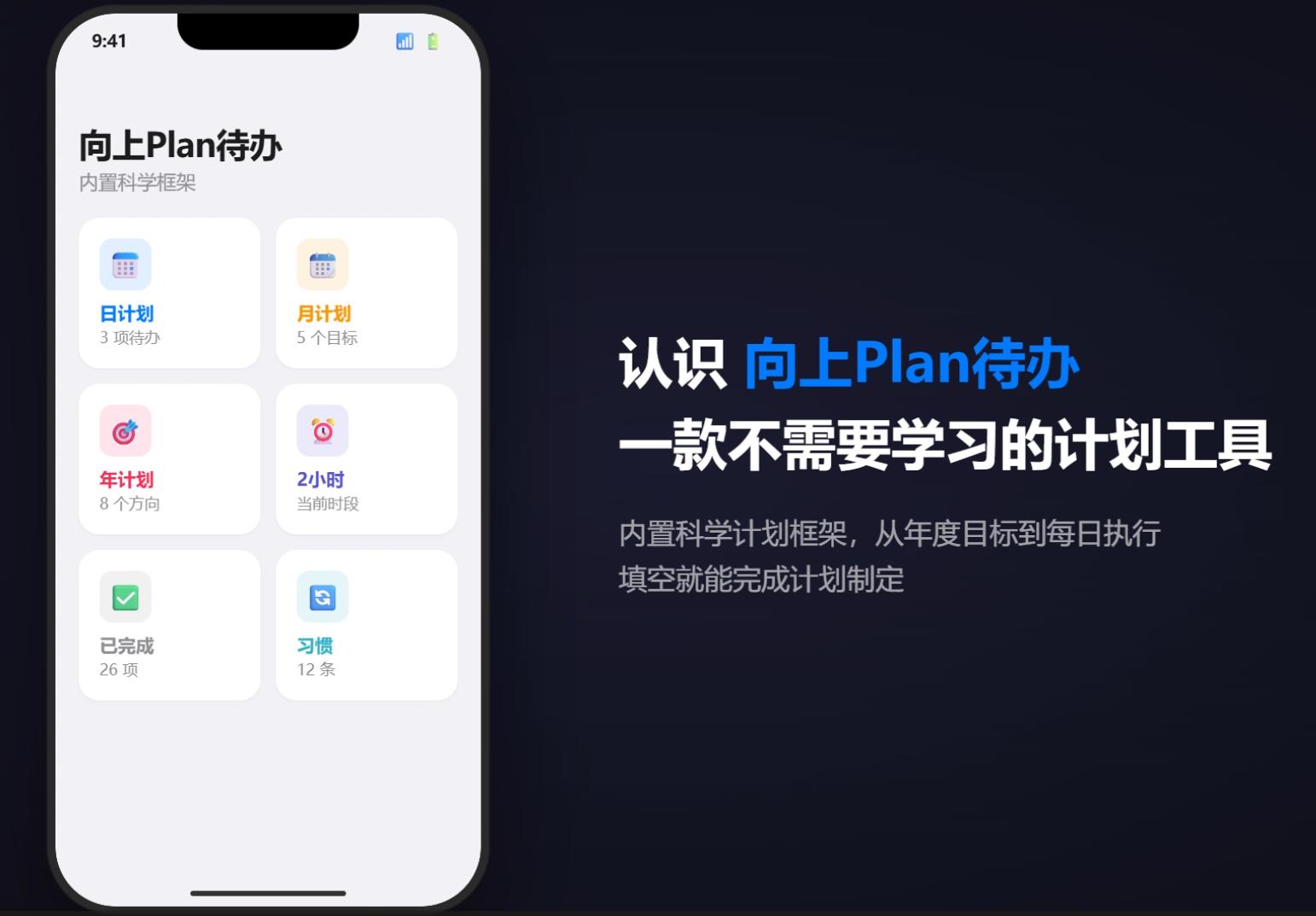
- Daily Plan — Add/Delete/Edit/Complete
- Monthly Plan — Add/Delete/Edit/Complete
- Annual Plan — Add/Delete/Edit/Complete
- Two Hours — 12 time segments, pure text input
- Completed — Archive view + one-click clear
- Habit — Thinking container, pure text display
All data is stored locally, operates offline, and has zero privacy risks.
Why six modules instead of more?
George Miller’s (1956) research on working memory provides the answer: the human working memory capacity is 7±2 chunks. Six modules fit perfectly within the comfort zone, allowing users to scan all entries at a glance with zero cognitive load.
Why is there no “Weekly Plan”?
This is the question I get asked the most, and it’s also my firmest product decision.
Cognitive Load Theory (John Sweller, 1988) tells us that when there are too many information units, working memory overload occurs, leading to decreased decision efficiency. Adding a weekly plan module pushes the total from six to seven, nearing Miller’s limit.
More importantly, functional equivalence analysis shows that all needs for a weekly plan can be covered by existing modules—just mark “complete in week X” in the monthly plan.
Design Principle: When the value of a functional module can be covered by existing modules, do not add a new module. In product development, the hardest part is not adding features but knowing what not to add.
Interaction Design: Every Pixel Reduces Cognitive Load
Apple Reminders Style, But More Understanding of Chinese Users
Rounded cards, circular icons, and clean layouts—visual language is modeled after Apple Reminders. However, precise differentiation was made on the functional level:
- Cross-Platform Coverage: Apple Reminders is limited to the Apple ecosystem, while Xiangshang Plan, based on WeChat mini-programs, is available to both iOS and Android users. With over 75% market share in the domestic Android market, Xiangshang Plan naturally covers a broader user base.
- Structured Templates: While Apple Reminders is flexible, it requires users to create collections and plan hierarchical structures. Xiangshang Plan directly embeds the “annual-monthly-daily” goal breakdown and “two-hour deep work” theory into the product structure, providing a scientific planning framework upon opening.
- Built-in Habit Module: Apple Reminders lacks a native habit tracking feature. Xiangshang Plan’s habit module allows users to input motivational quotes, thought patterns, and other mental encouragement content, integrating “methodology + psychological construction.”
- Zero Learning Cost: Six preset modules cover 90% of planning management scenarios, eliminating the need for users to understand concepts like “lists vs collections vs tags vs smart lists.”
Global Interaction Norms
- Swipe to Delete: Swiping beyond a threshold locks in, revealing a red delete area. A unified interaction paradigm across the app aligns with user intuition.
- Fixed Input Box at the Bottom: Click the plus sign → input → confirm. Three steps to complete, zero cognitive cost.
- Completion Animation: Hollow checkbox turns solid + checkmark, text gets a strikethrough, providing clear visual feedback.
- Native Page Scrolling: No use of scroll-view components, ensuring 100% compatibility with iOS and Android gestures.
Technical Implementation: Vibe Coding, All AI-Coded Product Experiment
This might be the most “counterintuitive” part of this article—
Every line of code in Xiangshang Plan was not written by me.
The entire development process used the Vibe Coding model: I was responsible for writing the PRD, defining product logic and interaction norms, while AI transformed the requirements into code. The tech stack is based on uni-app (Vue framework), compiled into a WeChat mini-program.
This isn’t about showing off; it’s about validating a product hypothesis: In 2026, as AI programming tools mature, the core value of product managers is shifting from “can it be done” to “should it be done, how to do it.”
Vibe Coding allows me, as a product person, to focus 100% of my energy on demand analysis, user research, interaction design, and theoretical validation, rather than wasting creativity on CSS adjustments and debugging.
This is also the viewpoint I want to express as a junior computer science student seeking product management internships: Future product managers may not need to write code but must be able to write PRDs that AI can execute accurately. Product thinking > technical implementation is no longer just a slogan but a methodology that can be practically validated.
Competitive Strategy: Differentiated Positioning without Direct Confrontation
Xiangshang Plan’s competitive strategy is clear:
We do not compete head-on with Apple Reminders but build barriers in user groups and scenarios they cannot cover.
Three core positioning points:
- Android Users (over 75% market share in the domestic market): Android users can also enjoy the quality experience of Apple Reminders.
- Users Lacking Methodology: Those who don’t know how to plan will automatically gain a scientific planning framework when they open Xiangshang Plan.
- Heavy WeChat Users: No installation, no registration, no login—open and use directly within WeChat.
Data Strategy and Privacy Philosophy
Version 1.0 adopts pure local storage, does not collect any personal information, does not request network permissions, and does not require registration or login.
This is not a technical limitation but a product philosophy: In an age of increasing data anxiety, “not collecting data” itself is a product competitiveness. Users’ plans, goals, and habits are the most private self-dialogues—we choose not to eavesdrop.
Version 1.5 will introduce one-click login with WeChat and cloud synchronization, but this will be a user-initiated choice, not a default requirement. Users will also be able to add photos to their plans.
Conclusion: A Junior Student’s Product Reflections
I am a junior computer science student currently seeking product manager internship opportunities.
Working on the Xiangshang Plan project has fundamentally changed me—I finally understand the essential difference between “product thinking” and “technical thinking.”
Technical thinking asks, “Can it be done?” Product thinking asks, “Should it be done?”
In this project, I cut more features than I implemented—no weekly plans, no tags, no priorities, no tracking, no social features, no data panels—every “not doing” decision was harder and more valuable than the “doing” decisions.
Vibe Coding has shown me the direction of the evolution of the product manager role: future PMs don’t need to write for loops but must be able to produce logically coherent and clearly defined PRDs that allow AI to become your development team.
If you are someone who “wants to plan but doesn’t know where to start,” feel free to search for the “Xiangshang Plan” mini-program on WeChat and give yourself a zero-threshold start.
If you are a senior product manager and would be willing to offer an internship opportunity after reading this article, my product sense and execution capabilities are all reflected in this mini-program.
Xiangshang Plan — returning planning to its essence and making simplicity a strength.
Comments
Discussion is powered by Giscus (GitHub Discussions). Add
repo,repoID,category, andcategoryIDunder[params.comments.giscus]inhugo.tomlusing the values from the Giscus setup tool.