
Anthropic Cuts Off OpenClaw Access
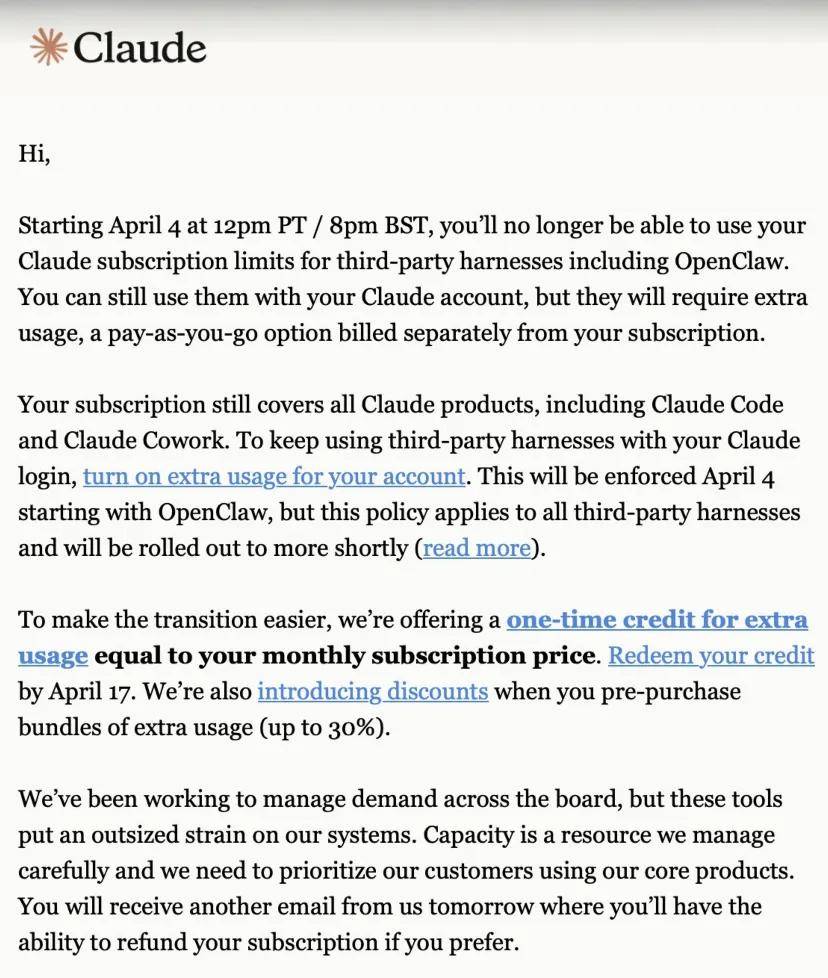
Recently, many OpenClaw users received an email from Anthropic announcing that starting April 4 at 12 PM PT, Claude subscriptions will no longer cover the use of third-party tools like OpenClaw.
Users can still log in to these tools through their Claude accounts but will need to pay separately, opting for additional usage packages (currently discounted) or directly using the Claude API key.

The email stated:
Starting April 4 at 12 PM PT (8 PM BST), you will no longer be able to use your Claude subscription credits for services in third-party tools (including OpenClaw).
You can still access these third-party tools through your Claude account, but it will require additional payment, billed separately from your subscription as a pay-per-use option.
Your subscription still covers all official Claude products, including Claude Code and Claude Cowork. To continue using third-party tools via your Claude account, please enable the additional usage feature.
This policy will first be implemented with OpenClaw but will apply to all third-party tools and will gradually extend to more platforms.
To help you transition smoothly, we will provide a one-time additional usage credit equivalent to your monthly subscription fee. Please redeem your credits by April 17. We are also launching discounted pre-purchase additional usage packages (up to 30% off).
Anthropic stated that they have been managing overall service demand, but these third-party tools have placed excessive pressure on their systems. Capacity is a resource that needs careful management, and they must prioritize customers using their core products.
Tomorrow, you will receive another email from us with an option to unsubscribe if you wish to request a refund.
OpenClaw Developer Responds
Peter Steinberger, the developer of OpenClaw, quickly responded, stating that he woke up to find his comments section filled with users complaining about Anthropic’s new restrictions.
“@davemorin and I tried to communicate with Anthropic, and in the end, we only managed to secure a one-week delay. Ironically, the timing is too coincidental; they first copied popular features from the community into their closed system and then shut out open-source tools.”
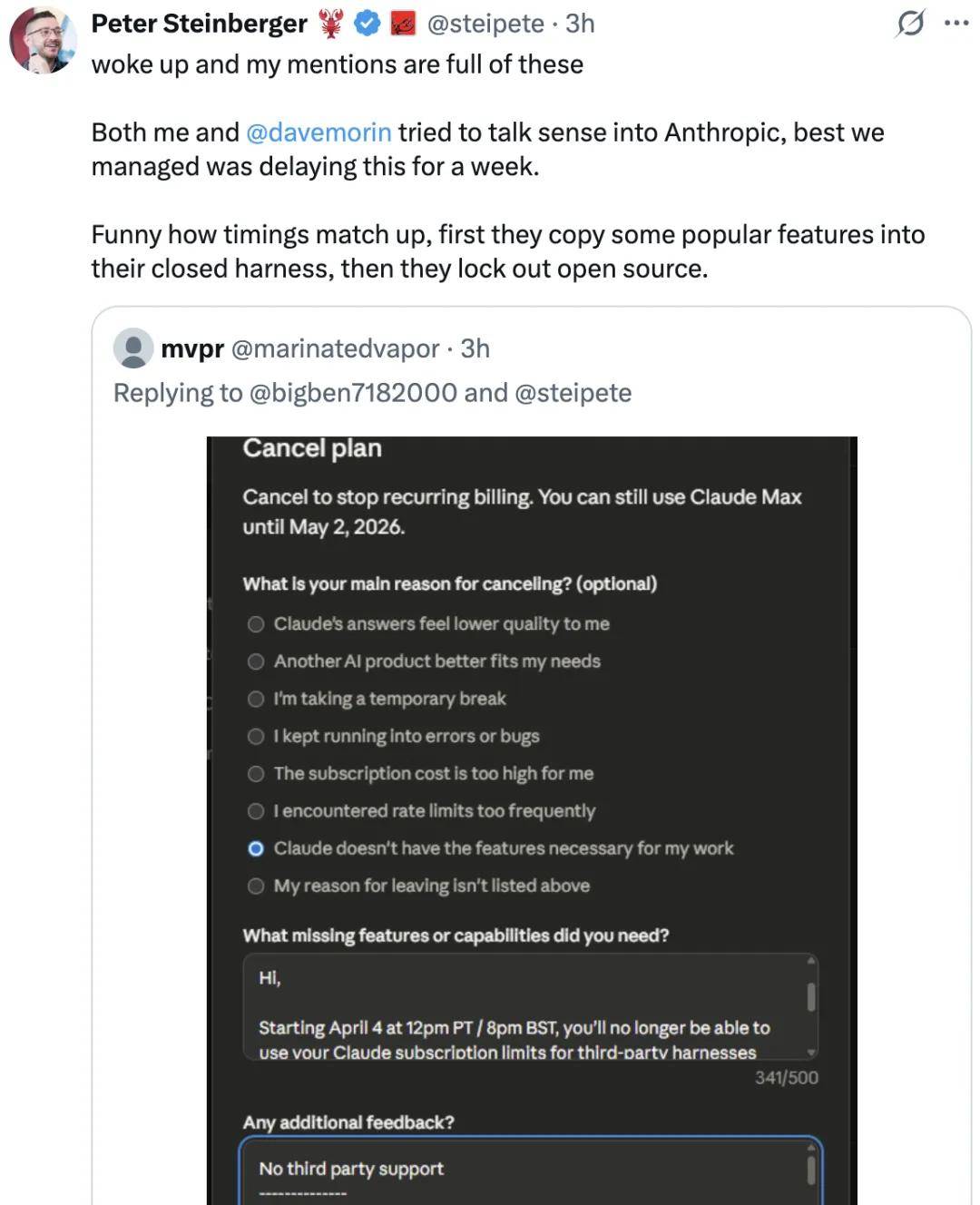
This implies a typical “copy and lock” operation, where they absorb innovations from the open-source community and then eliminate third-party access.
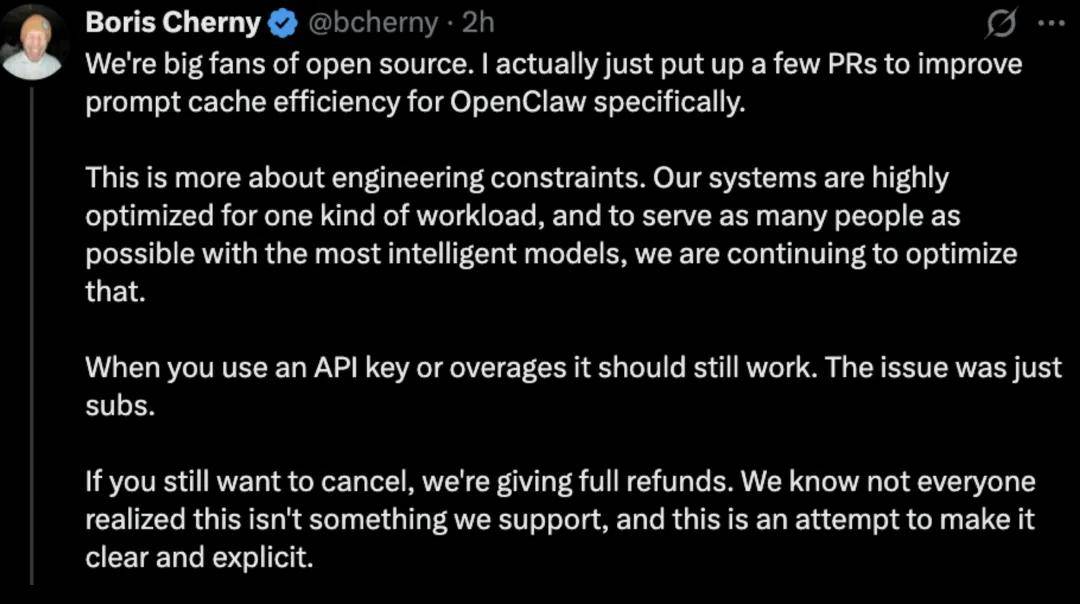
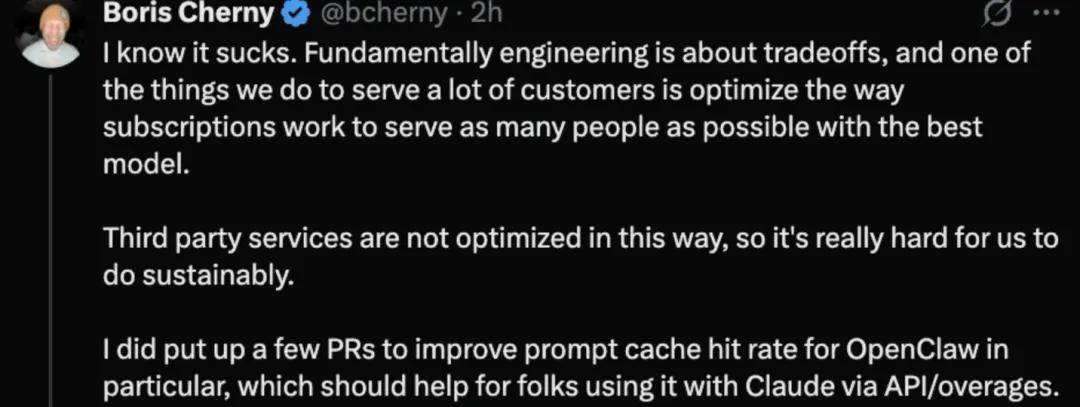
In response, Boris Cherny, head of Claude Code, stated, “We fully support the open-source spirit. In fact, I just submitted several PRs aimed at improving OpenClaw’s prompt caching efficiency. This policy adjustment is more about engineering constraints. Our system is highly optimized for specific types of workloads, and to serve as many users as possible with the smartest models, we will continue to push for optimizations in this area. When using an API key or additional usage, third-party tools can still operate normally. This issue only pertains to how subscription credits are utilized. If you still wish to cancel your subscription, we offer a full refund. We understand that not all users are aware that this has never been an officially supported usage method, and this policy adjustment aims to clarify the relevant regulations.”
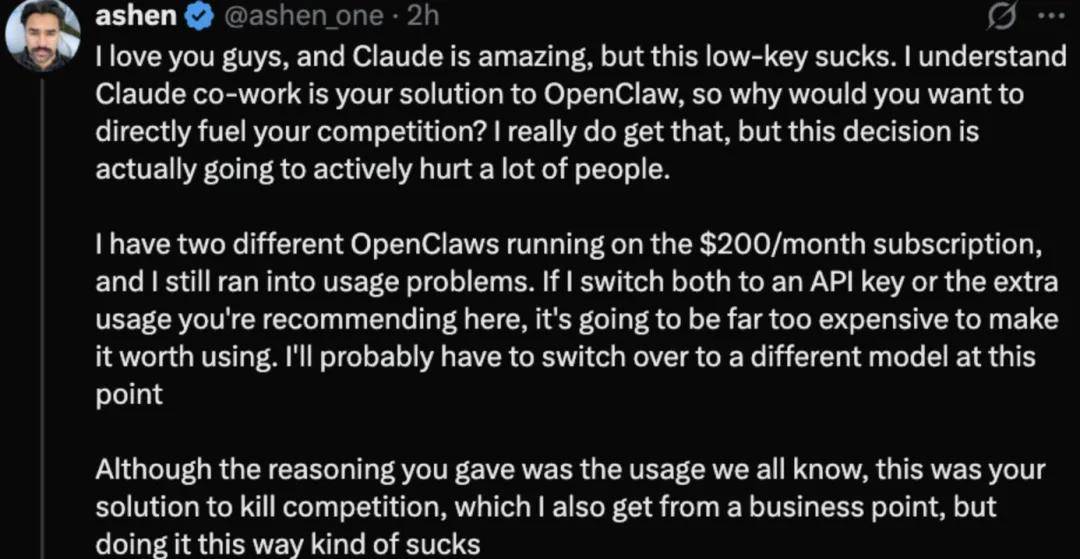
Some users believe that while Anthropic claims it’s due to high usage, the underlying reason is to eliminate competition. From a business perspective, this makes sense, but the execution feels somewhat unfair.
“Although I really like Claude and think it’s great, this decision is truly disappointing.”
He expressed understanding that Anthropic wants to promote its Claude Code to replace OpenClaw and does not want to continue “subsidizing” competitors, but this approach will hurt many heavy users. He himself runs two OpenClaw instances on a $200/month subscription and often encounters usage limits. If he now switches to an API key or additional payment package, the costs will become unfeasible, and he may have to switch to other models.
In the face of such criticism, Boris Cherny admitted, “I know this is bad.” However, he explained the underlying necessity: engineering is fundamentally about trade-offs. If the subscription model is to serve as many users as possible, resource consumption must be finely managed, and third-party tools like OpenClaw have not optimized this, leading to very inefficient consumption that is unsustainable in the long run.
The Financial Calculations Behind the Ban
Once the email was sent, users began to question: Why?
Anthropic’s move is fundamentally because Claude subscriptions are being ‘abused’, and losses are a fact.
Currently, Anthropic’s product line is divided into two categories: one is the Claude Pro subscription for general consumers (fixed monthly fee), and the other is the API version for developers (billed by usage).
Originally, users subscribed to Claude Pro could use their credits on OpenClaw, but this is extremely token-consuming. In high-frequency operation scenarios, the computational cost consumed in a day could exceed the user’s subscription fee.
For developers, if they all use tools like OpenClaw to “freeload” subscription credits to complete what should be paid API calls, then Anthropic’s API business, which is its core revenue source, would be severely threatened.
Thus, it can be said that third-party tools like OpenClaw are eating into the profits of model companies, forcing them to cut losses.
One user calculated for Anthropic, which may help clarify the situation.
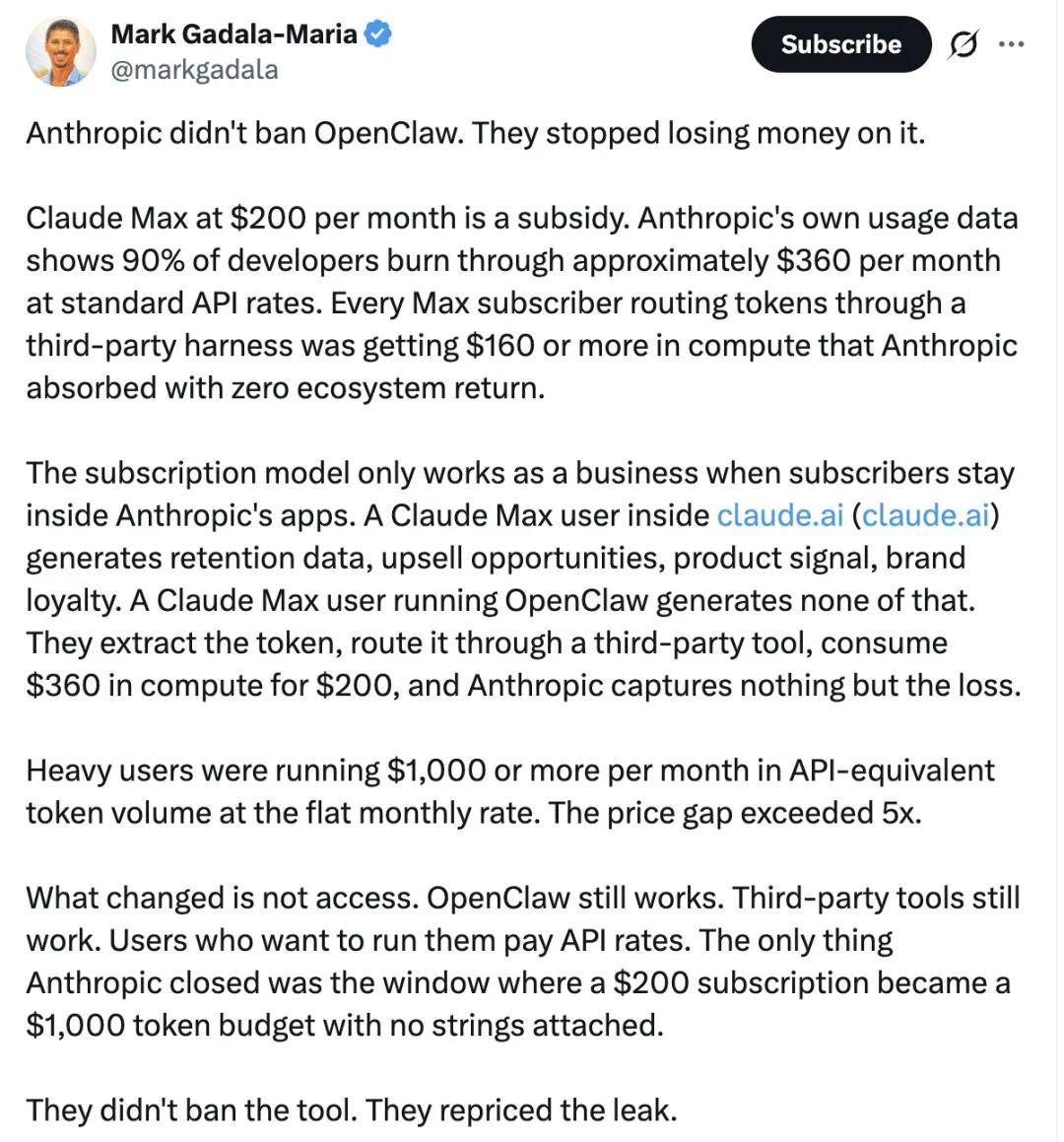
He believes that the current $200 monthly fee for the Claude Max subscription is essentially a subsidy. According to Anthropic’s own usage data, about 90% of developers spend around $360 per month at standard API prices. This means that each Max subscription user forwarding tokens through third-party tools (harness) is actually consuming at least $160 more in computational costs borne by Anthropic without bringing any ecosystem returns.
The subscription model only becomes a healthy business model when users stay within Anthropic’s own applications. For example, a user using Claude Max on the official Claude website generates retention data, creates upsell opportunities, provides product feedback signals, and strengthens brand loyalty. However, a user using OpenClaw generates no such value. They merely extract tokens, using third-party tools to call, spending $200 to consume $360 worth of computing power, leading to losses for Anthropic.
In more extreme cases, some heavy users run token usage equivalent to $1000 or even higher API usage on a fixed monthly fee, with price differences exceeding five times.
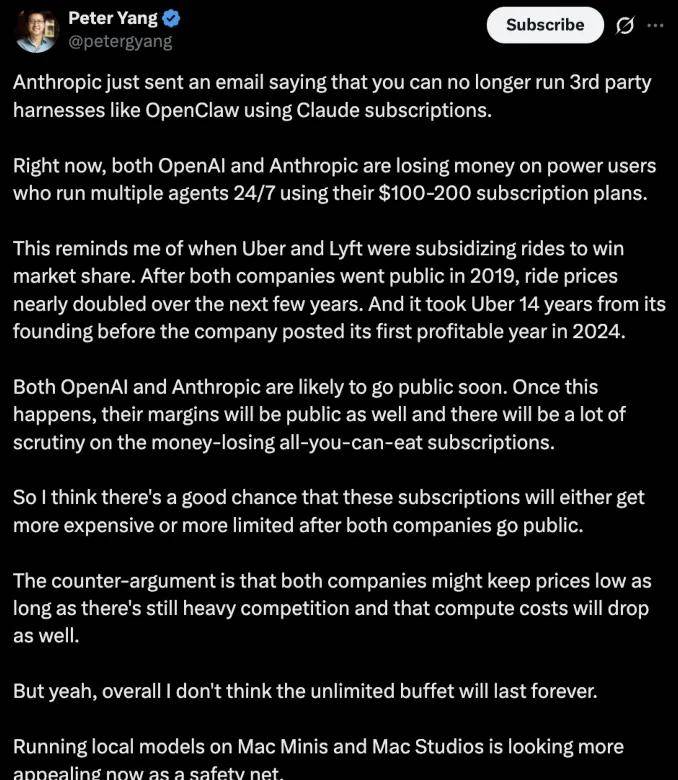
In fact, this dilemma is not unique to Anthropic. Currently, both OpenAI and Anthropic are losing money on heavy users who run multiple AI agents with $100 to $200 monthly subscriptions.
This brings to mind the era when Uber and Lyft used subsidies to capture the market. At that time, the two companies engaged in fierce price wars, burning cash for growth. However, after going public in 2019, ride prices nearly doubled in the following years, and Uber only achieved its first annual profit from its founding until 2024, after 14 years.
Now, OpenAI and Anthropic are likely entering a countdown to their IPO. Once public, profit margins will be transparent, and the “loss-making unlimited subscription” model will inevitably face strict scrutiny from investors and the market. At that point, the likelihood of subscription price increases or tighter usage restrictions will be significant.
Of course, some hold a different view: as long as market competition remains fierce, the two companies may continue to maintain low-price strategies to retain users; the continuous decline in computing costs may also offset some pressure. But overall, this “unlimited buffet” model is likely unsustainable.
Therefore, Anthropic’s move does not change whether OpenClaw can be used but rather that users can still use such third-party tools, just not at the previous bargain rates; they will need to pay according to API pricing.
So, what Anthropic has closed is only that “window”: a $200 subscription that could “inflate” into a $1000 computational budget.
They have not banned the tools; they have merely repriced this “loophole.”
If it were merely a financial loss, perhaps Anthropic would not have acted so decisively; the key is that if heavy users of high-frequency calls to third-party tools like OpenClaw continue unabated, it could “threaten” Anthropic’s user ecosystem.
Because computational reasoning power is currently the largest cost for major model companies, and their data centers are simply not sufficient. To cope with the load brought by tools like OpenClaw, the platform has no choice but to start throttling to maintain system stability. However, when tokens decrease, responses slow, and restrictions increase, it will lead to a worse user experience, triggering user dissatisfaction, and over time, may result in the risk of user attrition.
In other words, to some extent, when a large amount of resources are occupied by tools like OpenClaw, it is actually ordinary subscription users who are “paying” for them, and the ultimate consequence will be borne by ordinary users, potentially jeopardizing the platform’s ecosystem…
Additionally, Anthropic may also have considerations regarding the security and abuse risks of such third-party tools. OpenClaw early on utilized OAuth and WebSocket to bypass official API restrictions, making it very easy for hackers to exploit vulnerabilities for attacks. Therefore, Anthropic had to ensure the auditability and security of its model behavior by cutting off unofficial paths.
Of course, in response to this move, netizens have jokingly suggested that perhaps Anthropic wants to “replicate” OpenClaw’s success to promote its own products.
Recently, Anthropic launched Claude Code and Claude Cowork, whose functionalities, such as terminal operations, remote control, and automated programming, highly overlap with OpenClaw. Therefore, to ensure users remain within their ecosystem and pay related API fees, Anthropic inevitably will “clean up” those uncontrollable experiences that harm its own interests.
Moreover, attentive users should also note that in the email, Anthropic mentioned these two tools, implying that “if you can’t use OpenClaw, no problem; you still have Claude Code and Claude Cowork, which are official products…”
In conclusion, the reasons behind this are complex and multifaceted, but it is clear that major model companies are closing the “back doors” they previously allowed to attract users.
Comments
Discussion is powered by Giscus (GitHub Discussions). Add
repo,repoID,category, andcategoryIDunder[params.comments.giscus]inhugo.tomlusing the values from the Giscus setup tool.